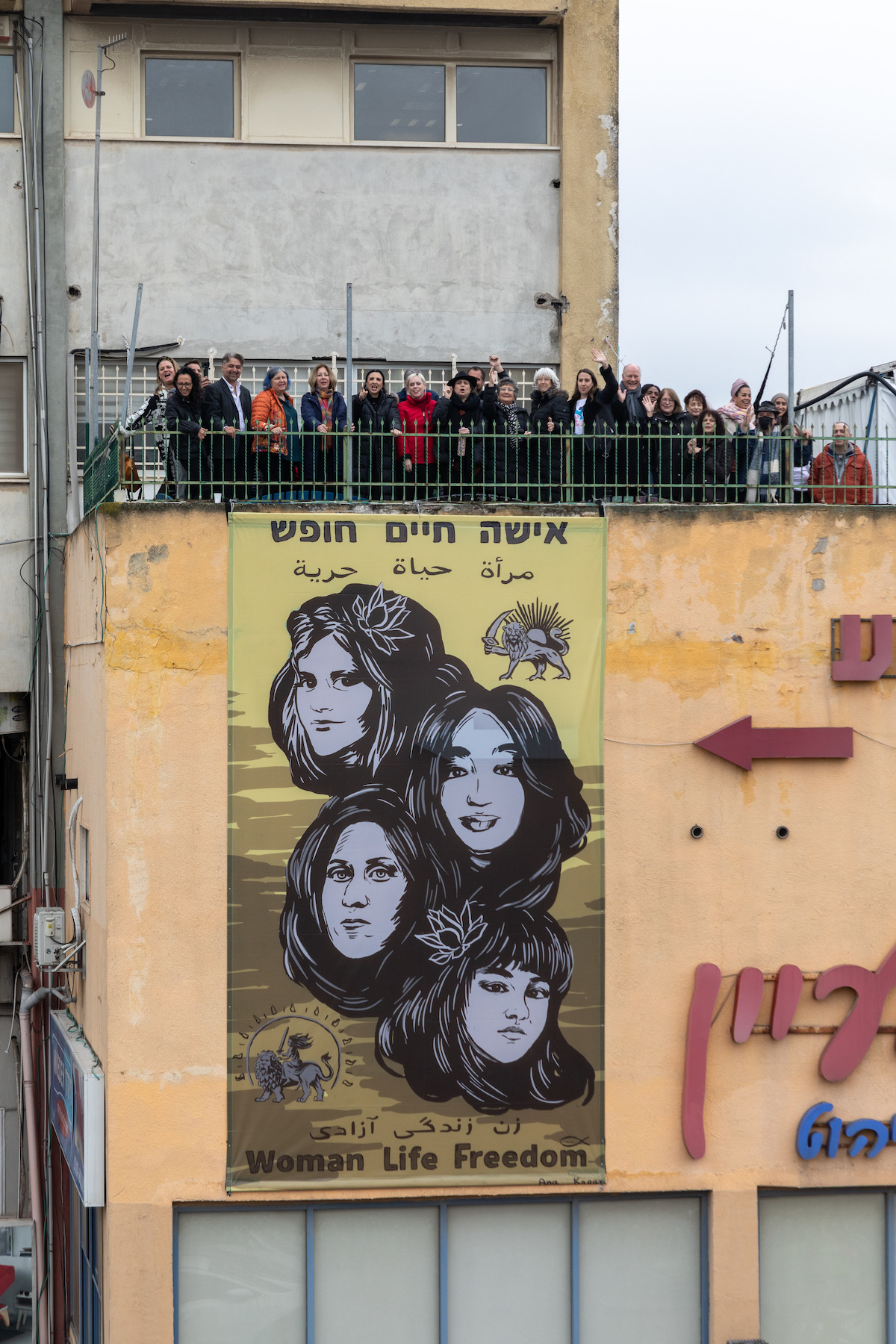
A wall in Talpiot
At the corner of Poalei Tzedek and Pierre Koenig streets in Jerusalem's Talpiot neighborhood, four portraits looked out from the El HaLev and MyPwr building. Unveiled in January 2023, the mural honored Mahsa Amini, Sarina Esmailzadeh, Fereshteh Ahmadi and Nika Shakarami. Their faces brought individual lives into a public statement of solidarity with the Woman Life Freedom movement.
Amini, a Kurdish Iranian woman, was visiting Tehran when Iran's morality police detained her. Her death in hospital on September 16, 2022 sparked protests across Iran. Esmailzadeh and Shakarami were teenagers when they died amid the protests. In her videos, Esmailzadeh sang and spoke about the freedoms she wanted for her generation. Shakarami disappeared during a demonstration in Tehran and was later found dead.
Ahmadi was a mother. She was fatally shot on a rooftop in Mahabad during the crackdown. Her brother said she had gone there to hang her son's clothing. Khalili told J., The Jewish News of Northern California, that he wanted the women's families to see the image of a mother, sister or daughter honored in Jerusalem.
From an invitation to an artwork
Khalili traces the project to a San Francisco mural he helped bring into being in November 2022. In his account, journalist Emily Schrader saw and shared an image, tagging Fleur Hassan-Nahoum, then Jerusalem's deputy mayor. She invited him to bring a work to Jerusalem and helped secure a wall on the building used by women's empowerment organizations El HaLev and MyPwr.
A Foreign Ministry contact introduced Khalili to Israeli artist Ana Kogan. At first, Kogan doubted his call was real. The Jerusalem Post reported that she designed the mural in partnership with him. Both described the urgency of the project: Khalili recalls that the work was completed about 26 days after his meeting with Hassan-Nahoum. Kogan told the newspaper that the response, including messages of thanks from Iranians, was emotional for her.
Symbols and a wider series
The design placed the four portraits beneath the words Woman Life Freedom, against a gold ground. Khalili recalls that Kogan suggested joining the women through their flowing hair; for him, the motif evokes the risks faced by women who defied compulsory veiling. He chose gold for its association with power in Iranian culture. The lion and sun draw on an older Iranian emblem, while a woman riding the lion holds a sword, which The Jerusalem Post described as a symbol of the women-led struggle.
The Talpiot work began Khalili's Israeli series. He continued working with artists and local partners in other cities. A later, separate two-portrait mosaic honoring Amini and Shirel Haim-Pour appeared at Jerusalem's Museum of Tolerance and was subsequently displayed at Rice University in Houston.
Explore the separate Shirel and Mahsa mosaic in Jerusalem ↗